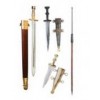
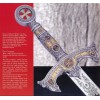
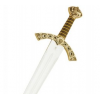
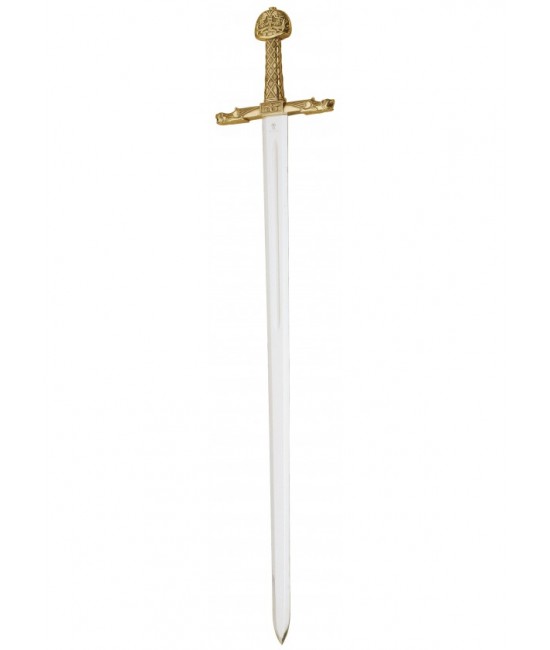
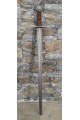
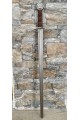
The Sword of Joyeuse, now housed in the Louvre Museum, is one of the most famous swords in history. Historical records associate the sword with Charlemagne, King of the Franks. If it truly belonged to the legendary ruler who lived around 1,200 years ago, Joyeuse would have been used in countless coronation ceremonies and become the subject of ancient myths and legends attributing magical powers to it.
The story begins in 802 A.D. According to legend, Joyeuse—whose name means “joyful” in French—was forged by the renowned swordsmith Galas, who spent three years completing it. The sword was said to possess magical properties. It was described as being so brilliant that it could outshine the sun and blind its wielder’s enemies in battle. It was also believed that anyone carrying the legendary blade could not be poisoned.
It is said that Charlemagne acquired the sword while returning from a campaign in Spain, after establishing camp in the region.
The 11th-century epic poem The Song of Roland describes the emperor riding into battle in magnificent armor with Joyeuse at his side, declaring that “never was there a sword to equal it; its color changed thirty times a day.” Among its legendary powers were the ability to dazzle enemies with a brilliant flash of light and to protect its bearer from all poisons.
One tale recounts how Charlemagne lost Joyeuse and promised a handsome reward to whoever found it. One of his knights returned the sword to him, whereupon Charlemagne thrust it into the ground and declared that the surrounding lands would belong to the knight forever. According to legend, this event gave rise to the French town of Joyeuse, which was founded on that site and named after the sword.
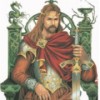
Charlemagne, also known as Carolus Magnus or Charles the Great, was born in 742 and became one of history’s most renowned military leaders. As King of the Franks and Emperor of Western Europe, he stood at the center of one of the greatest power structures of the medieval world: the Holy Roman Empire.
Charlemagne’s empire was built upon the military strength of the Franks, a confederation of Germanic tribes from the Rhineland. Filling the power vacuum left by the fall of the Roman Empire, they expanded across France, Germany, Italy, and many other territories, driven by ambition and, at times, by the desire to spread Christianity.
An aggressive conqueror, skilled politician, statesman, and successful military commander, Charlemagne shaped an empire whose influence endured in various forms well into the twentieth century.
Specifications
Overall length: 98 cm (38.6 in)
Width: 20.5 cm (8.1 in)
Weight: 1.7 kg (3.75 lb)
A high-quality sword from MARTO’s exclusive collection of Historical, Fantasy, and Legendary Swords.